bear
Word family
Longman Dictionary of Contemporary English 5++LDOCE 5++ldoce_705_zbear1 /beə $ ber/ ●●● S2 W2 verb (past tense bore /bɔː $ bɔːr/, past participle borne /bɔːn $ bɔːrn/) [transitive] 1 deal with STH 应付某事BRAVE to bravely accept or deal with a painful, difficult, or upsetting situation 忍受,忍耐,经受住 SYN stand She was afraid she wouldn’t be able to bear the pain. 她恐怕自己忍受不了这种痛苦。 Overcrowding makes prison life even harder to bear. 过度拥挤使监狱生活更加难以忍受。 Make the water as hot as you can bear. 把水温调到你能忍受的最高温度。 The humiliation was more than he could bear. 这样的羞辱是他万万不能忍受的。 Black people continue to bear the brunt of most racial violence (=have to deal with the most difficult or damaging part). 在大多数种族暴力事件中,黑人仍然是首当其冲的受害群体。 Passengers could be insulting, and stewardesses just had to grin and bear it (=accept it without complaining). 乘客有时会破口大骂,而乘务员只能微笑着默默忍受。 Experts were worried the financial system would not be able to bear the strain. 专家担心现行金融体系承受不了这样的压力。 RegisterIn everyday English, people usually say that they can’t stand something, rather than that they can't bear it: 在日常英语中,人们一般说can’t stand,而不说can’t bearI couldn’t stand the noise any longer. 我再也受不了那噪音了。2 can’t bear something spoken a) SUFFERto be so upset about something that you feel unable to accept it or let it happen 接受不了某事 SYN can’t stand Please don’t leave me. I couldn’t bear it. 请你不要离开我,我受不了。can’t bear the thought of (doing) something I just can’t bear the thought of having to start all over. 我想都不敢想要从头开始。can’t bear to do something I can’t bear to see her cry. 我不忍心看见她哭。can’t bear doing something I couldn’t bear not seeing him again. 我不能忍受再也见不到他。 b) DON'T LIKEto dislike something or someone very much, often so that they make you feel annoyed or impatient 忍受不了某事/某人 SYN can’t stand Oh, I really can’t bear him. 噢,我实在受不了他。can’t bear somebody doing something He can’t bear people smoking while he’s eating. 他受不了有人在他吃饭的时候吸烟。can’t bear doing something I can’t bear being cold. 我怕冷。3 bear (something) in mind REMEMBERto remember a fact or piece of information that is important or could be useful in the future 记住(某事),把(某事)记在心里 SYN keep (something) in mindbear in mind (that) Bear in mind that some children will need help. 记住,有些孩子需要帮助。4 accept/be responsible for 接受/承担 formalPAY FOR to be responsible for or accept something 承担,负担bear the costs/burden Each company will bear half the costs of development. 两家公司将均摊开发费用。 Fares have gone up, perhaps to more than the market will bear. 票价上涨了,而且可能超出了市场的承受能力。bear the responsibility/blame etc Developed countries bear much of the responsibility for environmental problems. 发达国家对环境问题负有主要责任。5 support 支持SUPPORT/HOLD UP to be under something and support it 支撑,承受,支承〔重量〕 SYN hold6 SHOW/BE A SIGN OFsign/mark 标记/记号 formal to have or show a sign, mark, or particular appearance, especially when this shows that something has happened or is true 带有〔某种标记或外观特征〕 SYN have7 bear a resemblance/relation to somebody/something LIKE/SIMILARto be similar to someone or something else 与某人/某物相似/有关8 MBBABY/HAVE A BABYbaby 婴儿 formal to give birth to a baby 生育9 bear fruit 10 INVESTIGATEable to be examined/compared etc 经得起检验/比较等 [often in negatives] to be suitable or good enough to be examined, compared, repeated etc without failing or being wrong 经得起〔检验、比较、重复等〕11 something doesn’t bear thinking about UNPLEASANTused to say that something is so upsetting or shocking that you prefer not to think about it 某事不堪设想12. bear interest if a bank account, investment etc bears interest, the bank pays you a particular amount of money for keeping your money in the account 生利息13 CARRYcarry 携带 literary to carry someone or something, especially something important 携带〔尤指重要的东西〕14 bring pressure/influence to bear (on somebody/something) POWERto use your influence or power to get what you want (对某人/某物)施加压力/影响15 bear witness/testimony to something formalSHOW/BE A SIGN OF to show that something is true or exists 见证某事,为某事证明16 ANGRYhave feelings 怀有某种情感 formal to have a particular feeling, especially a bad feeling 怀有〔某种情感,尤指不好的情感〕17 bear right/left TTCWAY/ROUTEto turn towards the right or left 向右转/向左转18 bear yourself formalWALKSTAND/BEAR to walk, stand etc in a particular way, especially when this shows your character 表现;保持某种举止19 CMOVE something OR somebodywind/water 风/水 literary if wind, water, or air bears something, it carries it somewhere 吹动;传送20 NAME OF A THINGname/title 姓名/头衔 formal to have a particular name or title 具有,拥有〔名字或头衔〕n COLLOCATIONSbear + NOUNbear the painHe knew that he couldn’t bear the pain much longer.bear the heat/coldSome people find it hard to bear the heat in the summer.bear the strain/pressureMark couldn’t bear the pressure of the job any longer.phrasescan hardly bear something (=find something very difficult or upsetting to do)He was so ashamed that he could hardly bear to look at her.be unable to bear somethingFiona was unable to bear the thought of selling the house.be hard to bearThe situation was very hard to bear.be more than somebody can bearHe sometimes felt the grief was more than he could bear.bear the brunt of something (=be in the worst position and have to deal with it)Shareholders will bear the brunt of the company’s financial troubles.grin and bear it (=accept it without complaining)It was a horrible job but she had to grin and bear it.5 FREQUENCY 使用频率
Examples from the Corpus
bear• A messenger arrived, bearing a letter from the ambassador.• Her loneliness was hard to bear, after her husband died.• They arrived in Israel on the same plane that bore Assad's coffin.• There Charles went solo again, unveiling a plaque - which bore both their names - as Diana stood meekly behind him.• Jean will never be able to bear children.• Some products that bear freshness dates are cheeses, breakfast cereals, bakery products, and mayonnaise.• Never would she let the earth bear fruit until she had seen her daughter.• Several of the guests arrived bearing gifts.• I really can't bear him.• The ice wasn't thick enough to bear his weight.• The trial was a great scandal but she bore it all with courage and dignity.• I can not bear it any longer, I am crying now.• My leg really hurts -- I'm not sure how much longer I can bear it.• Dissident radicals of all sorts were assumed to bear loyalty to alien ideologies, and deportation became the fate of many.• You know, as in, which one bore more excitement and panache.• For Blanche the atmosphere bore no resemblance to the glamorous, fun-filled evening promised in the advertisements.• An oak table bore several photographs of the family.• At the head of the procession a group of dark-suited men bore the coffin into the church.• The tunnel would have needed to be extremely strong to bear the full weight of the earth above.• The list bore the names of people still missing after the disaster.• Talking to a counsellor can help divorcees to bear the pain of separation.• He bore the pain stoically.• She bears the title of "Executive Director."• The baby's narrow neck looked too fragile to bear the weight of its head.• The police are asking residents to keep an eye out for a person bearing this description.• A close scrutiny of films showing lions killing zebras does not bear this out.• The melon rind bore traces of a rare type of the Salmonella bacteria.can bear• The rise in interest rates may be more than the economy can bear.• His face is enormous, almost more than I can bear.• Name seven different forms of ejecta from impact craters, and four topographic features that impact craters can bear.• They can bear a grudge for ever, like a fire in a mine.• Still I approve of his wish that the next time round he will become a woman so that he can bear children.• Obviously, too, they are policies which will take years of consistent application before they can bear fruit.• He can bear me no malice.• The designer whose work can bear such attention successfully is a rare talent indeed.• The use of computers in production is extending all the time, as fully-automated plants and robots can bear witness.bear the costs/burden• It is better that I alone bear the burden.• The rates were incapable of bearing the burden in their view and they expressed cautious support for a local income tax.• Share prices had therefore to bear the burden of adjustment.• For the moment, capital was bearing the costs of overaccumulation.• Is the potential for misidentification any less when the defence bear the burden of proof?• The buyers therefore had to bear the costs of the deterioration.• The insured must bear the costs of the Engineers fees unless liability is subsequently established under the policy.• The Legal Aid Fund bears the costs risk rather than the litigant.bear ... weight• Differences that had seemed slight when they were in their early twenties now bore social weight.• His arms were numb, his hands too weak to bear his weight.• I went down the steps, slowly, enjoying the way each step bore my weight.• As a foundation it is inadequate to bear the weight of the case that Mr. McGregor sought to build upon it.• If the floor is properly framed, you should not need extra support underneath to bear the weight of the fireplace.• The Hooper who existed in Brideshead Revisited, though, bore all the weight of Waugh's opprobrium.• Perhaps this distinction is too little to bear the weight placed on it.• But to my mind neither section 8 nor the Gillick decision will bear the weight which he seeks to place upon them.bears the scars• This boat was used in an Indiana Jones film and still bears the scars.• His twice broken kneecap still bears the scars - for Lawrence today was the test he's been waiting for.• The morning after, Jim Bob bears the scars of a sojourn in the moshpit.bear somebody a child/son/daughter• Even if women are raped, he says, they should be legally required to bear the children.• Next, their wives were fed since they could bear more children.• Perhaps it was just as well, Eline thought dismally, she was barren, unable to bear a child.• Women are now expected to bear 1.17 children, down from 1.89 in 1990.• She bore two children, Hercules to Zeus and Iphicles to Amphitryon.• Others develop the feeling of bearing a child more gradually.• The wide-ranging designs include a teddy bear switch for children's bedrooms.• Authorities fear the girl will attempt to bear the child without medical attention.bear scrutiny• A world that would be liked by contemporary people which do not always bear scrutiny.• The material did not bear scrutiny.• His relationship background didn't bear scrutiny either, having virtually abandoned his first wife and three other children.bear arms• All civilians possessing army-distributed guns must return them and undergo physical and psychological tests to determine their fitness to bear arms.• Esquires are described simply as men who bear arms.• The total census of the towns comes to just under 300,000 people of whom some 60,000 were capable of bearing arms.• There is no constitutional right to bear arms.• Women who choose to find employment in military institutions want therefore to be allowed to bear arms and to fight.• John Hostettler, R-Ind., who once suggested that the constitutional right to bear arms included nuclear weapons; and Rep.• He climbed in the Communist ranks to colonel, without ever bearing arms or wearing a uniform.• The right of the people to keep and bear arms shall not be infringed by law.bear (somebody) a grudge• Even back then it was clear they were bearing a grudge.• It would not do to have Miss Blagden imagine she bore any grudge.• Lets hope they don't bear a grudge!• He said both men came from deprived backgrounds and bore a grudge against the area in which they lived.• Does some one bear a grudge against Vallejo?• Drought-lovers are natural container plants and will not bear a grudge if you forget to water them.• Guenelon bears a grudge in his heart, which eventually blossoms into a scheme for revenge.• Otis, who bore lifelong grudges over provocations infinitely smaller than this, was realistic enough to know when he was had.ldoce_019_cbear2 ●●○ noun [countable] 1  HBAa large strong animal with thick fur, that eats flesh, fruit, and insects 熊2 American English informal something that is very difficult to do or to deal with 难做的事情;棘手的事情3. be like a bear with a sore head British English informalBAD-TEMPERED to be rude to people because you are feeling bad-tempered 脾气暴躁4. BFS technical someone who sells shares or goods when they expect the price to fall 〔股市或期货〕看跌的人,卖空的人 → bull
Examples from the Corpus
bear• Zeus got after her one morning in the guise of a brown bear.• With few bears and wolves about these days, elk rule their forest habitat.• Barnett replied drily that Davis's best option was to feed the gingerbread to his bears.• Also pictured with funnyman Les is Barnardos' best-known bear and official mascot, Barnaby.• The federal estate tax form is a real bear to fill out.• Buy teddy bear wrapping paper for decorations.• After three weeks out in the field Skipper looked like an overgrown teddy bear.• Visitors to the park are warned not to feed the bears.• Giraffes and upstanding bears are more popular than snakes, rats and spiders.From Longman Business Dictionarybearbear /beəber/ noun [countable]FINANCE someone who thinks that prices of shares, bonds, currencies, or basic goods are going to fall, and who may sell shares, bonds etc they do not actually own, expecting to be able to obtain them more cheaply later, before they have to deliver them to the buyerThe bears argue that after the stock market’s dramatic rise, shares are bound to fall again.The bears took hold of the company, sending the shares 5p lower to 159p.A contingent of dollar bears (=people who think that the price of the dollar is going to fall) still persists in the market. → compare bullOrigin bear1 Old English beran bear2 Old English berabear1 verb →10-20
→REGISTER1 →n COLLOCATIONS1 →5 FREQUENCY1 →PHRASAL VERBS1bear2 nounLDOCE OnlineChinese
→REGISTER1 →n COLLOCATIONS1 →5 FREQUENCY1 →PHRASAL VERBS1bear2 nounLDOCE OnlineChinese
bravely Business with accept a or deal Corpus to
bear
bear1 S2 W2 /beə $ ber/ 
 verb (past tense bore /bɔː $ bɔːr/, past participle borne /bɔːn $ bɔːrn/) [transitive]
SYN stand:

She was afraid she wouldn’t be able to bear the pain.
Overcrowding makes prison life even harder to bear.
Make the water as hot as you can bear.
The humiliation was more than he could bear.
Black people continue to bear the brunt of most racial violence (=have to deal with the most difficult or damaging part).
Passengers could be insulting, and stewardesses just had to grin and bear it (=accept it without complaining).
Experts were worried the financial system would not be able to bear the strain.
REGISTER
In everyday English, people usually say that they can’t stand something, rather than that they can't bear it:
▪I couldn’t stand the noise any longer.
2. can’t bear something spoken
a. to be so upset about something that you feel unable to accept it or let it happen
SYN can’t stand:
Please don’t leave me. I couldn’t bear it.
can’t bear the thought of (doing) something
I just can’t bear the thought of having to start all over.
can’t bear to do something
I can’t bear to see her cry.
can’t bear doing something
I couldn’t bear not seeing him again.
b. to dislike something or someone very much, often so that they make you feel annoyed or impatient
SYN can’t stand:
Oh, I really can’t bear him.
can’t bear somebody doing something
He can’t bear people smoking while he’s eating.
can’t bear doing something
I can’t bear being cold.
3. bear (something) in mind to remember a fact or piece of information that is important or could be useful in the future
SYN keep (something) in mind
bear in mind (that)
Bear in mind that some children will need help.
4. ACCEPT/BE RESPONSIBLE FOR formal to be responsible for or accept something
bear the costs/burden
Each company will bear half the costs of development.
Fares have gone up, perhaps to more than the market will bear.
bear the responsibility/blame etc
Developed countries bear much of the responsibility for environmental problems.
5. SUPPORT to be under something and support it
SYN hold:
My leg was painful, and I wasn’t sure it would bear my weight.
a tray bearing a bottle and several glasses
a load-bearing wall
6. SIGN/MARK formal to have or show a sign, mark, or particular appearance, especially when this shows that something has happened or is true
SYN have:
The letter bore no signature.
a car bearing diplomatic license plates
The labels bear a yellow and black symbol.
The town still bears the scars of the bombings during the war.
The store bears the hallmarks (=it has the qualities) of a family-owned business.
7. bear a resemblance/relation to somebody/something to be similar to someone or something else:
The child bore a striking resemblance to his father.
The things she says bear little relation to what she actually does.
8. BABY formal to give birth to a baby:
She might never be able to bear children.
bear somebody a child/son/daughter
She bore him three sons.
9. bear fruit
a. if a plan, decision etc bears fruit, it is successful, especially after a long period of time:
Charles’s diplomacy eventually bore fruit.
b. if a tree bears fruit, it produces fruit
10. ABLE TO BE EXAMINED/COMPARED ETC [often in negatives] to be suitable or good enough to be examined, compared, repeated etc without failing or being wrong:
The production figures did not bear scrutiny.
We believe our pupils’ results will bear comparison with any in Scotland.
The story is well known, but it certainly bears repeating.
11. something doesn’t bear thinking about used to say that something is so upsetting or shocking that you prefer not to think about it:
The long-term consequences of a nuclear leak don’t bear thinking about.
12. bear interest if a bank account, investment etc bears interest, the bank pays you a particular amount of money for keeping your money in the account
13. CARRY literary to carry someone or something, especially something important:
The wedding guests arrived, bearing gifts.
The US Constitution states that the people have a right to bear arms.
14. bring pressure/influence to bear (on somebody/something) to use your influence or power to get what you want:
Unions can bring pressure to bear on governments.
15. bear witness/testimony to something formal to show that something is true or exists:
The empty workshops bear witness to the industrial past.
16. HAVE FEELINGS formal to have a particular feeling, especially a bad feeling
bear (somebody) a grudge (=continue to feel annoyed after a long time)
It was an accident. I don’t bear any grudges.
bear somebody no malice/ill will etc (=not feel angry)
He was just doing his job, and I bore him no malice.
17. bear right/left to turn towards the right or left:
When you reach the fork in the trail, bear left.
18. bear yourself formal to walk, stand etc in a particular way, especially when this shows your character:
She bore herself with great dignity.
19. WIND/WATER literary if wind, water, or air bears something, it carries it somewhere:
The sound of music was borne along on the wind.
20. NAME/TITLE formal to have a particular name or title:
He bore the name ‘Magnus’.
■ bear + NOUN
▪bear the pain He knew that he couldn’t bear the pain much longer.
▪bear the heat/cold Some people find it hard to bear the heat in the summer.
▪bear the strain/pressure Mark couldn’t bear the pressure of the job any longer.
■ phrases
▪can hardly bear something (=find something very difficult or upsetting to do) He was so ashamed that he could hardly bear to look at her.
▪be unable to bear something Fiona was unable to bear the thought of selling the house.
▪be hard to bear The situation was very hard to bear.
▪be more than somebody can bear He sometimes felt the grief was more than he could bear.
▪bear the brunt of something (=be in the worst position and have to deal with it) Shareholders will bear the brunt of the company’s financial troubles.
▪grin and bear it (=accept it without complaining) It was a horrible job but she had to grin and bear it.
bear down phrasal verb
1. bear down on somebody/something
a. to move quickly towards a person or place in a threatening way:
a storm bearing down on the island
b. to behave in a threatening or controlling way towards a person or group:
Federal regulators have been bearing down on campaign contributors.
2. to use all your strength and effort to push or press down on something
bear on/upon something phrasal verb formal
to relate to and possibly influence something:
the national policies which bear on these problems
bear somebody/sth↔ out phrasal verb
if facts or information bear out a claim, story, opinion etc, they help to prove that it is true
SYN support:
Evidence bears out the idea that students learn best in small groups.
bear up phrasal verb
to show courage or determination during a difficult or unpleasant time:
How is he bearing up since the accident?
bear with somebody/something phrasal verb
1. bear with me spoken used to ask someone politely to wait while you find out information, finish what you are doing etc:
Bear with me a minute, and I’ll check if Mr Garrard’s in.
2. to be patient or continue to do something difficult or unpleasant:
It’s boring, but please bear with it.
bear2 noun [countable]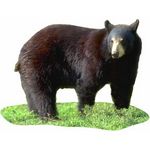
1. a large strong animal with thick fur, that eats flesh, fruit, and insects:
a mother bear and her cubs ⇨ grizzly bear, polar bear, teddy bear
2. American English informal something that is very difficult to do or to deal with:
The chemistry test was a bear.
3. be like a bear with a sore head British English informal to be rude to people because you are feeling bad-tempered
4. technical someone who sells shares or goods when they expect the price to fall ⇨ bull
| I |
verb (past tense bore /bɔː $ bɔːr/, past participle borne /bɔːn $ bɔːrn/) [transitive] Word Family: verb: bear; noun: bearer; adverb: bearably ≠ unbearably; adjective: bearable ≠ unbearable
Language: Old English
Origin: beran
1. DEAL WITH SOMETHING to bravely accept or deal with a painful, difficult, or upsetting situation Origin: beran
SYN stand:
REGISTER
In everyday English, people usually say that they can’t stand something, rather than that they can't bear it:
▪
2. can’t bear something spoken
a. to be so upset about something that you feel unable to accept it or let it happen
SYN can’t stand:
can’t bear the thought of (doing) something
can’t bear to do something
can’t bear doing something
b. to dislike something or someone very much, often so that they make you feel annoyed or impatient
SYN can’t stand:
can’t bear somebody doing something
can’t bear doing something
3. bear (something) in mind to remember a fact or piece of information that is important or could be useful in the future
SYN keep (something) in mind
bear in mind (that)
4. ACCEPT/BE RESPONSIBLE FOR formal to be responsible for or accept something
bear the costs/burden
bear the responsibility/blame etc
5. SUPPORT to be under something and support it
SYN hold:
6. SIGN/MARK formal to have or show a sign, mark, or particular appearance, especially when this shows that something has happened or is true
SYN have:
7. bear a resemblance/relation to somebody/something to be similar to someone or something else:
8. BABY formal to give birth to a baby:
bear somebody a child/son/daughter
9. bear fruit
a. if a plan, decision etc bears fruit, it is successful, especially after a long period of time:
b. if a tree bears fruit, it produces fruit
10. ABLE TO BE EXAMINED/COMPARED ETC [often in negatives] to be suitable or good enough to be examined, compared, repeated etc without failing or being wrong:
11. something doesn’t bear thinking about used to say that something is so upsetting or shocking that you prefer not to think about it:
12. bear interest if a bank account, investment etc bears interest, the bank pays you a particular amount of money for keeping your money in the account
13. CARRY literary to carry someone or something, especially something important:
14. bring pressure/influence to bear (on somebody/something) to use your influence or power to get what you want:
15. bear witness/testimony to something formal to show that something is true or exists:
16. HAVE FEELINGS formal to have a particular feeling, especially a bad feeling
bear (somebody) a grudge (=continue to feel annoyed after a long time)
bear somebody no malice/ill will etc (=not feel angry)
17. bear right/left to turn towards the right or left:
18. bear yourself formal to walk, stand etc in a particular way, especially when this shows your character:
19. WIND/WATER literary if wind, water, or air bears something, it carries it somewhere:
20. NAME/TITLE formal to have a particular name or title:
| COLLOCATIONS |
▪
▪
▪
■ phrases
▪
▪
▪
▪
▪
▪
bear down phrasal verb
1. bear down on somebody/something
a. to move quickly towards a person or place in a threatening way:
b. to behave in a threatening or controlling way towards a person or group:
2. to use all your strength and effort to push or press down on something
bear on/upon something phrasal verb formal
to relate to and possibly influence something:
bear somebody/sth↔ out phrasal verb
if facts or information bear out a claim, story, opinion etc, they help to prove that it is true
SYN support:
bear up phrasal verb
to show courage or determination during a difficult or unpleasant time:
bear with somebody/something phrasal verb
1. bear with me spoken used to ask someone politely to wait while you find out information, finish what you are doing etc:
2. to be patient or continue to do something difficult or unpleasant:
| II |
noun [countable] Language: Old English
Origin: bera
Origin: bera
1. a large strong animal with thick fur, that eats flesh, fruit, and insects:
2. American English informal something that is very difficult to do or to deal with:
3. be like a bear with a sore head British English informal to be rude to people because you are feeling bad-tempered
4. technical someone who sells shares or goods when they expect the price to fall ⇨ bull
hate to have a strong feeling of dislike for sb/sth 指厌恶、讨厌、憎恶 NOTE Although hate is generally a very strong verb, it is also commonly used in spoken or informal English to talk about people or things that you dislike in a less important way, for example a particular type of food.尽管 hate 通常为语气很强的动词,但亦常用于口语或非正式英语中,谈论不太喜欢的人或物,如某种食物等 :◆ He hates violence in any form. 他憎恶任何形式的暴力。 ◆ I've always hated cabbage. 我从来都讨厌吃卷心菜。 dislike ( to not like sb/sthrather
指不喜欢、厌恶 NOTE Dislike is a rather formal word; it is less formal, and more usual, to say that youdon't like sb/sth, especially in spoken English.* dislike 为相当正式的用语,don't like 则较非正式,而且较常用,尤其在英语口语中 :◆ I don't like it when you phone me so late at night. 我不喜欢你夜里这么晚给我打电话。 can't stand ( used to emphasize that you really do not like sb/sthrather
强调不喜欢、受不了、不能容忍 :◆ I can't stand his brother. 他弟弟让我受不了。 ◆ She couldn't stand being kept waiting. 叫她等着,她会受不了。 despise to dislike and have no respect for sb/sth 指鄙视、蔑视、看不起 :◆ He despised himself for being so cowardly. 他为自己如此怯懦而自惭形秽。 can't bear used to say that you dislike sth so much that you cannot accept or deal with it 指无法承受、应付不了 :◆ I can't bear having cats in the house. 家里有猫我可受不了。
can't stand or can't bear? 用 can't stand 还是 can't bear?
loathe to hate sb/sth very much 指极不喜欢、厌恶 :◆ They loathe each other. 他们相互讨厌。 NOTE Loathe is generally an even stronger verb thanhate , but it can also be used more informally to talk about less important things, meaning 'really don't like'.* loathe 通常比 hate 语气还强,但亦可用于非正式场合指不太重要的事情,意为确实不喜欢 :◆ Whether you love or loathe their music, you can't deny their talent.无论你是否喜欢他们的音乐,你都无法否认他们的才能。 detest ( to hate sb/sth very muchrather
指厌恶、憎恨、讨厌 :◆ They absolutely detest each other. 他们完全是相互憎恨。
Patterns
I hate/dislike/can't stand/can't bear/loathe/detest doing sth .I hate/can't bear to do sth .I hate/dislike/can't stand/can't bear it when… I really hate/dislike/can't stand/despise/can't bear/detest sb/sth.I absolutely hate/can't stand/loathe/detest sb/sth.

especially

especially
especially