die
Longman Dictionary of Contemporary English 5++LDOCE 5++die1 /daɪ/ ●●● S1 W1 verb (died, dying, dies) [intransitive] 1 become dead 死去DIE to stop living and become dead 死去,死亡 He died in 1985 at the age of 76. 他1985年去世,终年76岁。 Her father died suddenly in an accident when she was only ten. 她年仅10岁时父亲突然死于一场意外事故。die of/from The animals died of starvation in the snow. 这些动物在雪中饿死了。 patients who are dying from cancer 垂危的癌症病人 She died peacefully in her sleep at the age of 98. 她在睡眠中安然辞世,享年98岁。die for something (=be killed while fighting to defend something) 为某事物献出生命 Do you believe in anything enough to die for it? 你有足以让你为之献出生命的信仰吗?die young/happy/poor She died young, at the age of 27. 她27岁英年早逝。 The bullet went straight through his head, and he died instantly. 子弹穿过他的头部,他当场死亡。to your dying day/until the day you die (=until you die) 直到你死的时候 It must remain a secret until the day I die. 这事我到死也不能说。somebody’s dying breath/wish (=someone’s last breath or wish) 某人最后一口气/临终遗愿 It was his dying wish that the house be opened to the public. 把这幢房子向公众开放是他的临终遗愿。die a hero/martyr/rich man etc My uncle died a hero. 我叔叔死得很英勇。die a natural/violent/agonizing death Did she die a natural death? (=did she die naturally, or did someone kill her?) 她是自然死亡吗?n GRAMMAR: Prepositions with die• Someone dies of or from a disease or injury: He died of a heart attack.He died from a heart attack. Die of is more common than die from. ✗Don’t say: He died because of a heart attack. • Someone dies in an accident: He died in a car crash. ✗Don’t say: He died by a car crash.• Someone dies for a person, place, or idea that they want to protect: These men died for our freedom.2 disappear 消失DISAPPEAR to disappear or stop existing 消失,不复存在 Our love will never die. 我们的爱始终不渝。 The family name will die with him (=disappear when he dies). 他去世后,家族的姓氏也将随之消失。 He’s one of a dying breed (=a type of person that is no longer common). 他这样的人已经快要绝种了。3 machines 机器 informalTSTOP HAPPENING to stop working 停止运转 SYN break down4 be dying for something/to do something spokenWANT to want something very much 极想要某物/渴望做某事5 be dying of hunger/thirst/boredom spoken to be very hungry, thirsty, bored etc 都快要饿死/渴死/厌烦死了6 I nearly died/I could have died spokenEMBARRASSED used to say that you felt very surprised or embarrassed 我太惊讶了,我尴尬死了7 die of embarrassment/shame to be very embarrassed or ashamed 尴尬得要命/羞愧得要死8 I’d rather die spokenWANT# used to say very strongly that you do not want to do something 我死也不,我宁愿死〔用来强烈表示不想做某事〕9 in the dying minutes/seconds/moments (of something) during the last minutes or seconds before the end of something 在(某事的)最后几分钟/最后几秒钟/结束前的一刻10. old habits/traditions/customs die hard CHANGE/BECOME DIFFERENTused to say that it takes a long time to change to a new way of doing something 旧的习惯/传统/习俗很难改变11. never say die spokenCONTINUE/NOT STOP used to encourage someone to continue doing something that is difficult 别放弃〔用于鼓励某人继续做困难的事〕12 die a/the death informalFAIL to gradually fail or be forgotten 慢慢失败[消亡]13 die laughing spokenLAUGH to laugh a lot 笑死了14 to die for informal extremely nice, attractive, or desirable 极好的,非常吸引人的n COLLOCATIONSdie + ADVERBdie instantly (=as soon as an accident, injury etc happens)He was shot in the head and died instantly.die suddenlyShe died suddenly of a heart attack, in Amsterdam.die youngThey had seven children and three of them died young.die aloneHe had a fear of dying alone.die unmarriedHe died unmarried in 1922.die aged 35/50 etcHer father died aged 84.die peacefully (=calmly and without pain)The nurses said that she died very peacefully.die tragicallyHis wife had died tragically in an accident.die penniless (=without any money)Van Gogh died penniless because nobody bought his paintings.phrasesdie in your sleepDuring the night he died in his sleep.die in suspicious/mysterious circumstances (=used to say that someone may have been killed)He got involved with drug dealers and died in mysterious circumstances.die a natural death (=of natural causes, rather than being killed)The coroner concluded that Wilkins had died a natural death.die a sudden/violent/slow etc deathAt the end of the play, the main character dies a violent death.die a hero/rich man etcHe died a hero on the battlefield.die in childbirth (=giving birth to a baby)More women died in childbirth in the past. THESAURUSdie to stop being alive, as a result of old age or illness 死去,死亡I want to see Ireland again before I die. 我想在死之前再去爱尔兰看看。No wonder your plants always die – you don’t water them enough. 难怪你种的植物总会死掉——你水浇得不够。nHis son died of liver cancer three years ago.pass away to die – used when you want to avoid using the word ‘die’, in order to show respect or to avoid upsetting someone 去世〔委婉语,为表示尊敬或避免引起某人不快〕My wife had just passed away, and I didn’t want to be around people. 我妻子刚去世,我想一个人静一静。npass on to pass away – use this especially when you believe that the soul has a life after the death of the bodyI’m sorry, Emily, but your mother has passed on.lose your life to be killed in a terrible event 〔在不幸事件中〕丧生Hundreds of people lost their lives when the ship overturned in a storm. 轮船在暴风雨中倾覆,数百人失去了生命。perish literary to die in a terrible event – used especially in literature and news reports 〔在不幸事件中〕死亡,罹难〔尤用于文学作品和新闻报道〕Five children perished before firefighters could put out the blaze. 五名儿童在消防员扑灭大火之前遇难。give your life/lay down your life formal to die in order to save someone, or because of something that you believe in 〔为了拯救别人或为了某种信仰〕献出自己的生命,牺牲We honor the men and women who have given their lives in service of their country. 我们向为国捐躯的英雄儿女致敬。drop dead informal to suddenly die, when people do not expect you to 猝死,暴毙One day, he came home from work and dropped dead of a heart attack. 一天,他下班回到家,因心脏病发作而猝然死去。nkick the bucket/pop your clogs British English, buy the farm American English informal to die – used when you are not talking seriously about deathIt’s not like I’m going to kick the bucket tomorrow. PHRASAL VERBS→ See Verb table
Examples from the Corpus
die• Broadway classics like "A Chorus Line" will never die.• The engine coughed and died.• She said she had ruined her eyes by crying too much when her husband died.• Yonatan Barnea also was a soldier on his way back to base when he died.• He was very sick and we knew he might die.• I want to see Ireland again before I die.• Many people are worried about growing old and dying alone.• By the time the white petals died and the mint-colored berry poked out, the leaf shine was gilded tight and waxy.• I must, I must, I will die if I remain silent.• In the spring of her 93rd year, Miss Grantley died in her sleep.• The meeting began with a minute's silence for those who had died in Northern Ireland in the past 23 years.• A 72 year old woman died of a perforated colon 11 days after completing the trial, despite continuing prednisolone treatment.• His son died of liver cancer three years ago.• The autopsy said he had died of natural causes, but his family is not convinced.• Her husband had died two years earlier.• Christopher and Matthew Key died when their parents' car collided with another on a waterlogged road.• Night guard duty was killing time that had died while you weren't looking and so it went on for ever.• No wonder your plants always die - you don't water them enough.die a natural/violent/agonizing death• Company support slipped away and the adhesives programme died a natural death.• His father seemed a more promising candidate for that role and he had died a natural death.• Sometimes I think they just want to let the whole thing die a natural death.• The flower phase died a natural death.• The Revolution remained a military sedition and appeared likely to die a natural death.• Is it surprising that he should die a natural death from a heart attack?dying breed• He's among the a dying breed.• Little old ladies who had relished home baking were a dying breed and the younger generation simply couldn't relate to them.• There are still a few of this dying breed around.• The truth is that Eddie represents a dying breed of the playboy racing driver.die2 noun [countable] 1. TIa metal block used to press or cut something into a particular shape 金属模具,铸模,压模2. DGa dice 骰子,色子3. the die is cast DECIDEused to say that a decision has been taken and cannot now be changed 事情已成定局,覆水难收Examples from the Corpus
die• A die could survive over a long period of time.• The likely total number of dies can then be multiplied by the average number of coins per die.Origin die1 (1100-1200) Probably from Old Norse deyjadie1 verb →n GRAMMAR1 →n COLLOCATIONS1
→THESAURUS1 →PHRASAL VERBS1die2 nounLDOCE OnlineChinese
→THESAURUS1 →PHRASAL VERBS1die2 nounLDOCE OnlineChinese
dead living stop become and to Corpus
die
die1 S1 W1 /daɪ/ 
 verb (past tense and past participle died, present participle dying, third person singular dies) [intransitive]

He died in 1985 at the age of 76.
Her father died suddenly in an accident when she was only ten.
die of/from
The animals died of starvation in the snow.
patients who are dying from cancer
She died peacefully in her sleep at the age of 98.
die for something (=be killed while fighting to defend something)
Do you believe in anything enough to die for it?
die young/happy/poor
She died young, at the age of 27.
The bullet went straight through his head, and he died instantly.
to your dying day/until the day you die (=until you die)
It must remain a secret until the day I die.
sb’s dying breath/wish (=someone’s last breath or wish)
It was his dying wish that the house be opened to the public.
die a hero/martyr/rich man etc
My uncle died a hero.
die a natural/violent/agonizing death
Did she die a natural death? (=did she die naturally, or did someone kill her?)
2. DISAPPEAR to disappear or stop existing:
Our love will never die.
The family name will die with him (=disappear when he dies).
He’s one of a dying breed (=a type of person that is no longer common).
3. MACHINES informal to stop working
SYN break down:
The engine spluttered and died.
die on somebody (=stop working while they are using it)
The mower just died on me.
4. be dying for something/to do something spoken to want something very much:
I’m dying for a cup of tea.
She was dying to ask where he’d got it.
I’m dying to see what it is.
5. be dying of hunger/thirst/boredom spoken to be very hungry, thirsty, bored etc:
Do you fancy a cup of tea? I’m dying of thirst.
6. I nearly died/I could have died spoken used to say that you felt very surprised or embarrassed:
I nearly died when I saw it was my ex-husband!
7. die of embarrassment/shame to be very embarrassed or ashamed:
The room was such a mess, I just died of embarrassment.
8. I’d rather die spoken used to say very strongly that you do not want to do something:
I’d rather die than work for him!
9. in the dying minutes/seconds/moments (of something) during the last minutes or seconds before the end of something:
United scored an equaliser in the dying minutes of the game.
10. old habits/traditions/customs die hard used to say that it takes a long time to change to a new way of doing something
11. never say die spoken used to encourage someone to continue doing something that is difficult
12. die a/the death informal to gradually fail or be forgotten:
The rumour gradually died a death.
13. die laughing spoken to laugh a lot:
We nearly died laughing when he told us.
14. to die for informal extremely nice, attractive, or desirable:
She had hair to die for.
■ die + ADVERB
▪die instantly (=as soon as an accident, injury etc happens) He was shot in the head and died instantly.
▪die suddenly She died suddenly of a heart attack, in Amsterdam.
▪die young They had seven children and three of them died young.
▪die alone He had a fear of dying alone.
▪die unmarried He died unmarried in 1922.
▪die aged 35/50 etc Her father died aged 84.
▪die peacefully (=calmly and without pain) The nurses said that she died very peacefully.
▪die tragically His wife had died tragically in an accident.
▪die penniless (=without any money) Van Gogh died penniless because nobody bought his paintings.
■ phrases
▪die in your sleep During the night he died in his sleep.
▪die in suspicious/mysterious circumstances (=used to say that someone may have been killed) He got involved with drug dealers and died in mysterious circumstances.
▪die a natural death (=of natural causes, rather than being killed) The coroner concluded that Wilkins had died a natural death.
▪die a sudden/violent/slow etc death At the end of the play, the main character dies a violent death.
▪die a hero/rich man etc He died a hero on the battlefield.
▪die in childbirth (=giving birth to a baby) More women died in childbirth in the past.
▪ die to stop being alive, as a result of old age or illness: I want to see Ireland again before I die. | No wonder your plants always die – you don’t water them enough. | His son died of liver cancer three years ago.
▪pass away to die – used when you want to avoid using the word ‘die’, in order to show respect or to avoid upsetting someone: My wife had just passed away, and I didn’t want to be around people.
▪pass on to pass away – use this especially when you believe that the soul has a life after the death of the body: I’m sorry, Emily, but your mother has passed on.
▪lose your life to be killed in a terrible event: Hundreds of people lost their lives when the ship overturned in a storm.
▪perish literary to die in a terrible event – used especially in literature and news reports: Five children perished before firefighters could put out the blaze.
▪give your life/lay down your life formal to die in order to save someone, or because of something that you believe in: We honor the men and women who have given their lives in service of their country.
▪drop dead informal to suddenly die, when people do not expect you to: One day, he came home from work and dropped dead of a heart attack.
▪kick the bucket/pop your clogs British English, buy the farm American English informal to die – used when you are not talking seriously about death: It’s not like I’m going to kick the bucket tomorrow.
die away phrasal verb
if sound, wind, or light dies away, it becomes gradually weaker until you cannot hear, feel, or see it:
Her voice died away as she saw the look on David’s face.
She waited until the footsteps had died away.
die back phrasal verb
if a plant dies back, it dies above the ground but remains alive at its roots
die down phrasal verb
if something dies down, it becomes less strong, active, or violent:
Don’t worry, the gossip will soon die down.
when the excitement had died down
die off phrasal verb
if a group of people or animals die off, they die one by one until there are no more of them
die out phrasal verb
to disappear or stop existing completely:
The wild population of koalas is in danger of dying out.
There will be outbreaks of rain, gradually dying out later.
die2 noun [countable]
1. a metal block used to press or cut something into a particular shape
2.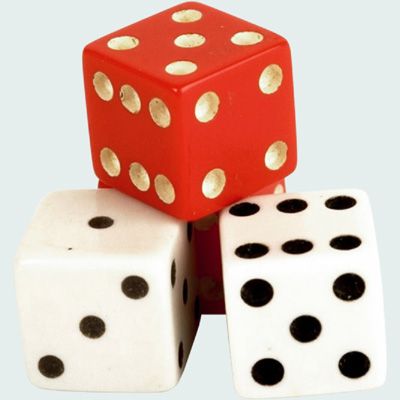
a dice
3. the die is cast used to say that a decision has been taken and cannot now be changed
| I |
verb (past tense and past participle died, present participle dying, third person singular dies) [intransitive] Date: 1100-1200
Origin: Probably from Old Norse deyja
1. BECOME DEAD to stop living and become dead:Origin: Probably from Old Norse deyja
die of/from
die for something (=be killed while fighting to defend something)
die young/happy/poor
to your dying day/until the day you die (=until you die)
sb’s dying breath/wish (=someone’s last breath or wish)
die a hero/martyr/rich man etc
die a natural/violent/agonizing death
2. DISAPPEAR to disappear or stop existing:
3. MACHINES informal to stop working
SYN break down:
die on somebody (=stop working while they are using it)
4. be dying for something/to do something spoken to want something very much:
5. be dying of hunger/thirst/boredom spoken to be very hungry, thirsty, bored etc:
6. I nearly died/I could have died spoken used to say that you felt very surprised or embarrassed:
7. die of embarrassment/shame to be very embarrassed or ashamed:
8. I’d rather die spoken used to say very strongly that you do not want to do something:
9. in the dying minutes/seconds/moments (of something) during the last minutes or seconds before the end of something:
10. old habits/traditions/customs die hard used to say that it takes a long time to change to a new way of doing something
11. never say die spoken used to encourage someone to continue doing something that is difficult
12. die a/the death informal to gradually fail or be forgotten:
13. die laughing spoken to laugh a lot:
14. to die for informal extremely nice, attractive, or desirable:
| COLLOCATIONS |
▪
▪
▪
▪
▪
▪
▪
▪
▪
■ phrases
▪
▪
▪
▪
▪
▪
| THESAURUS |
▪
▪
▪
▪
▪
▪
▪
die away phrasal verb
if sound, wind, or light dies away, it becomes gradually weaker until you cannot hear, feel, or see it:
die back phrasal verb
if a plant dies back, it dies above the ground but remains alive at its roots
die down phrasal verb
if something dies down, it becomes less strong, active, or violent:
die off phrasal verb
if a group of people or animals die off, they die one by one until there are no more of them
die out phrasal verb
to disappear or stop existing completely:
| II |
noun [countable]1. a metal block used to press or cut something into a particular shape
2.
a dice
3. the die is cast used to say that a decision has been taken and cannot now be changed


especially