planet
Longman Dictionary of Contemporary English 5++LDOCE 5++plan·et /ˈplænɪt/ ●●● W3 noun [countable] 1  HAa very large round object in space that moves around the Sun or another star 行星 Mercury is the smallest of all the planets. 水星是行星中最小的一颗。 Is there life on other planets? 其他行星上有生命吗? the future of planet Earth 地球的未来 ► Don’t say ‘in a planet’. Say on a planet.不要说 ‘in a planet’. 而要说 on a planet.2 somebody is (living) on another planet/what planet is somebody on? spokenSTUPID/NOT SENSIBLE used humorously to say that someone’s ideas are not at all practical or sensible 某人是外星人〔幽默用法,表示某人的想法完全不切实际或不明智〕 He thinks motherhood is glamorous – what planet is he on? 他觉得当母亲令人向往--他是外星人吧?3 the planet WORLDthe world – used especially when talking about the environment 地球〔尤用于谈论环境〕 a safer future for the planet 地球更安全的将来 —planetary adjective [only before noun] the planetary system 行星系
HAa very large round object in space that moves around the Sun or another star 行星 Mercury is the smallest of all the planets. 水星是行星中最小的一颗。 Is there life on other planets? 其他行星上有生命吗? the future of planet Earth 地球的未来 ► Don’t say ‘in a planet’. Say on a planet.不要说 ‘in a planet’. 而要说 on a planet.2 somebody is (living) on another planet/what planet is somebody on? spokenSTUPID/NOT SENSIBLE used humorously to say that someone’s ideas are not at all practical or sensible 某人是外星人〔幽默用法,表示某人的想法完全不切实际或不明智〕 He thinks motherhood is glamorous – what planet is he on? 他觉得当母亲令人向往--他是外星人吧?3 the planet WORLDthe world – used especially when talking about the environment 地球〔尤用于谈论环境〕 a safer future for the planet 地球更安全的将来 —planetary adjective [only before noun] the planetary system 行星系Examples from the Corpus
planet• In this way the differentiation of a planet may act to slow down the operation of the heat engine.• One of my boyfriends said that it's as if I was from another planet.• We will take the animals to different planets.• The entire planet is fluid, like a star.• Certainly, evidence of intelligent civilizations on planets orbiting distant stars would be an epochal event in human history.• It is almost certain that, during the Earth's early history, the planet was a frequent victim of cometary impacts.• Saturn is the planet with rings around it.• The orbital motion of the earth provided a causal explanation for why the planets appeared to meander across the sky.Origin planet (1100-1200) Old French planete, from Late Latin planeta, from Greek planes “wanderer”plan·et nounChineseSyllable
in large space round Corpus very a that object
planet
plan‧et W3 /ˈplænət, ˈplænɪt/
 noun [countable]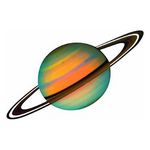
1. a very large round object in space that moves around the Sun or another star:

Mercury is the smallest of all the planets.
Is there life on other planets?
the future of planet Earth
► Do not say ‘in a planet’. Say on a planet.
2. somebody is (living) on another planet/what planet is somebody on? spoken used humorously to say that someone’s ideas are not at all practical or sensible:
He thinks motherhood is glamorous – what planet is he on?
3. the planet the world – used especially when talking about the environment:
a safer future for the planet
—planetary adjective [only before noun]:
the planetary system
■ in the sky
▪star a large ball of burning gas in space, which can be seen at night as a point of light in the sky: The dark night sky was clear and full of stars.
▪planet one of the large objects that goes around the sun, for example the Earth, Saturn, Mercury, or Mars: The planet Uranus was discovered in 1781.
▪sun the star that gives us light and heat, around which the planets move. There are also many millions of other suns in the universe: The sun came out from behind a cloud. | a dying sun
▪moon the round object that moves around the Earth every 28 days, or a similar object that goes around another planet: The moon rose in the night sky. | Titan is one of the moons of Saturn.
▪asteroid a mass of rock that moves around the sun. Most asteroids are found between Jupiter and Mars: the asteroid belt
▪pulsar a type of star that is far away in space and produces radiation and RADIO WAVES
▪quasar an object like a star that is far away in space and shines extremely brightly
▪supernova a very large exploding star
▪constellation a group of stars that forms a particular pattern and has a name: The constellation of Orion is one of the most easily recognizable patterns of stars in the night sky.
▪galaxy one of the large groups of stars that make up the universe: Astronomers have detected a galaxy 11 billion light years away.
▪the universe all space, including all the stars and planets: How many planets in the universe have life?
plan‧et W3 /ˈplænət, ˈplænɪt/
noun [countable] Date: 1100-1200
Language: Old French
Origin: planete, from Late Latin planeta, from Greek planes 'wanderer'
Language: Old French
Origin: planete, from Late Latin planeta, from Greek planes 'wanderer'
1. a very large round object in space that moves around the Sun or another star:
► Do not say ‘in a planet’. Say on a planet.
2. somebody is (living) on another planet/what planet is somebody on? spoken used humorously to say that someone’s ideas are not at all practical or sensible:
3. the planet the world – used especially when talking about the environment:
—planetary adjective [only before noun]:
| THESAURUS |
▪
▪
▪
▪
▪
▪
▪
▪
▪
▪
▪
