saw
Longman Dictionary of Contemporary English 5++LDOCE 5++saw1 /sɔː $ sɒː/ verb 1.x-refthe past tense of see see的过去式→ See Verb tablesaw2 ●●○ noun [countable] 1.  TZa tool that you use for cutting wood. It has a flat blade with an edge cut into many V shapes. 锯2 a short familiar phrase or sentence that is considered to contain some truth about life 格言,谚语 SYN proverb, saying That reminds me of the old saw about being careful about what you wish for. 这使我想起了许愿需谨慎的那条古训。
TZa tool that you use for cutting wood. It has a flat blade with an edge cut into many V shapes. 锯2 a short familiar phrase or sentence that is considered to contain some truth about life 格言,谚语 SYN proverb, saying That reminds me of the old saw about being careful about what you wish for. 这使我想起了许愿需谨慎的那条古训。Examples from the Corpus
saw• Their versatility means a circular saw is not always needed.• In sum, their experience reverses the old saw about immigration and prosperity.• Now, over there are wheelbarrows, rakes, pitchforks, saws, the lot.• Albert stated, shook his head, and revved up the saw.• A metal L-shaped guide holds the work underneath a very thin saw blade, held between metal uprights.• All you hear now is the buzzing of those saws.old saw• Now that is no joke because one of these big old saws can weigh the best part of half a ton.• Which brings to mind that old saw about being careful what you wish for..• That reminds me of that old saw about being careful what you wish for.• How like you to produce that old saw out of your bag of tricks!• I am mindful of the old saw that economic policy is much too important to be left to the economists.• In sum, their experience reverses the old saw about immigration and prosperity.• There is no truth to the old saw that business is always more efficient than government, he has learned.• We all grew up with the old saw that a picture is worth a thousand words.saw3 ●●○ verb (past tense sawed, past participle sawn /sɔːn $ sɒːn/ or sawed American English) [intransitive, transitive] 1 TBCCUTto cut something using a saw 〔用锯子〕锯,锯开 She was in the backyard sawing logs. 她在后院锯木头。saw through He sawed through a power cable by mistake. 他误把电缆给锯断了。► see thesaurus at cut2 saw at something phrasal verb CUTto cut something with a repeated backwards and forwards movement 拉锯似的来回切 He sawed at the loaf with a blunt knife. 他用一把钝刀来回切面包。3 saw something ↔ off phrasal verb CUTto remove something by cutting it off with a saw 把…锯掉 We sawed off the dead branches. 我们把枯枝锯掉。4 saw something ↔ up phrasal verb CUTto cut something into many pieces, using a saw 把…锯成小块 The tree was cut down and sawn up for logs. 这棵树被砍倒,锯成了一段段木头。→ See Verb tableExamples from the Corpus
saw• We had to saw the wood to the right length, and then nail the pieces together.• It took all morning to saw up the logs.saw through• The prisoners escaped by sawing through the bars in their cell.Origin saw2 Old English saguthe past Corpus see tense of
See see for more
saw
saw1 /sɔː $ sɒː/ 

the past tense of see
saw2 noun [countable]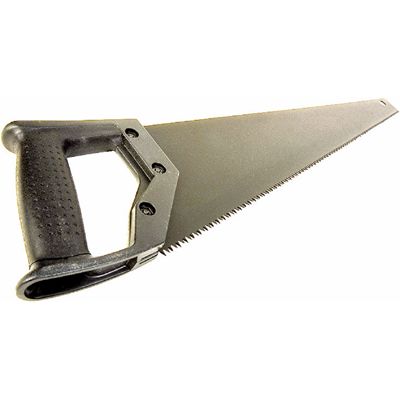
1. a tool that you use for cutting wood. It has a flat blade with an edge cut into many V shapes.
2. a short familiar phrase or sentence that is considered to contain some truth about life
SYN proverb, saying:

That reminds me of the old saw about being careful about what you wish for.
saw3 verb (past tense sawed, past participle sawn /sɔːn $ sɒːn/ or sawed American English) [intransitive and transitive]
to cut something using a saw:
She was in the backyard sawing logs.
saw through
He sawed through a power cable by mistake.
saw at something phrasal verb
to cut something with a repeated backwards and forwards movement:
He sawed at the loaf with a blunt knife.
saw something ↔ off phrasal verb
to remove something by cutting it off with a saw:
We sawed off the dead branches.
saw something ↔ up phrasal verb
to cut something into many pieces, using a saw:
The tree was cut down and sawn up for logs.
▪ cut to divide something into two or more pieces, especially using a knife or scissors: Do you want me to cut the cake? | He cut off the lower branches.
▪snip to quickly cut something, especially using scissors: I snipped the label off. | The hairdresser snipped away at her hair.
▪slit to make a long narrow cut through something, especially using a knife: He slit the envelope open with a penknife. | She slit through the plastic covering.
▪slash to cut something quickly and violently with a knife, making a long thin cut: Someone had slashed the tyres on his car. | He tried to slash his wrists.
▪saw to cut wood, using a saw (=a tool with a row of sharp points): Saw the wood to the correct length.
▪chop to cut wood, vegetables, or meat into pieces: Bill was outside chopping up firewood with an axe. | They chopped down the old tree. | finely chopped onion
▪slice to cut bread, meat, or vegetables into thin pieces: I’ll slice the cucumber. | Slice the bread thinly.
▪dice to cut vegetables or meat into small square pieces: First dice the apple into cubes.
▪grate to cut cheese or a hard vegetable by rubbing it against a special tool: Grate the cheese and sprinkle it over the vegetables.
▪peel to cut the outside part off something such as a potato or apple: I peeled the potatoes and put them in a saucepan.
▪carve to cut thin pieces from a large piece of meat: Uncle Ray carved the turkey.
▪mow to cut the grass in a garden, park etc: A gardener was mowing the lawn.
▪trim (also clip ) to cut a small amount off something, especially to make it look neater: He was trimming his beard. | Trim the excess fat off the meat.
| I |
the past tense of see
| II |
noun [countable] Language: Old English
Origin: sagu
Origin: sagu
1. a tool that you use for cutting wood. It has a flat blade with an edge cut into many V shapes.
2. a short familiar phrase or sentence that is considered to contain some truth about life
SYN proverb, saying:
| III |
verb (past tense sawed, past participle sawn /sɔːn $ sɒːn/ or sawed American English) [intransitive and transitive]to cut something using a saw:
saw through
saw at something phrasal verb
to cut something with a repeated backwards and forwards movement:
saw something ↔ off phrasal verb
to remove something by cutting it off with a saw:
saw something ↔ up phrasal verb
to cut something into many pieces, using a saw:
| THESAURUS |
▪
▪
▪
▪
▪
▪
▪
▪
▪
▪
▪
▪
also
