tiger
Longman Dictionary of Contemporary English 5++LDOCE 5++ti·ger /ˈtaɪɡə $ -ər/ ●●● W3 noun [countable]  HBAa large wild animal that has yellow and black lines on its body and is a member of the cat family 虎,老虎 → paper tiger →5 see picture at 见图 big cat
HBAa large wild animal that has yellow and black lines on its body and is a member of the cat family 虎,老虎 → paper tiger →5 see picture at 见图 big catExamples from the Corpus
tiger• He tried to avoid it, but after the first blow struck, he went after them like a tiger.• A tiger had been ravaging the countryside and killing the villagers' livestock.• Not only have tigers doubled in numbers, but other species and habitats have benefited.• Did you hear about the night hunter who shot tigers by aiming right between their luminous eyes?• Throughout the Far East, the tiger has always been regarded as an animal of magical properties.• Except at mating time, tigers are solitary animals.• This is a typically preposterous concoction, with tiger stripes on the long seat, horse heads for arms.• He was like a wounded tiger.Origin tiger (1200-1300) Old French tigre, from Latin tigris, from Greekti·ger nounChineseSyllable
wild animal lines has large yellow Corpus a that black and
See ldoce491jpg for more
tiger
ti‧ger /ˈtaɪɡə $ -ər/
 noun [countable]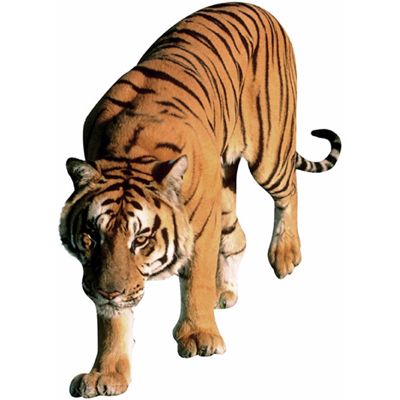
a large wild animal that has yellow and black lines on its body and is a member of the cat family ⇨ paper tiger
ti‧ger /ˈtaɪɡə $ -ər/
noun [countable] Date: 1200-1300
Language: Old French
Origin: tigre, from Latin tigris, from Greek
Language: Old French
Origin: tigre, from Latin tigris, from Greek
a large wild animal that has yellow and black lines on its body and is a member of the cat family ⇨ paper tiger