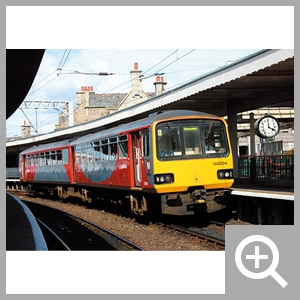
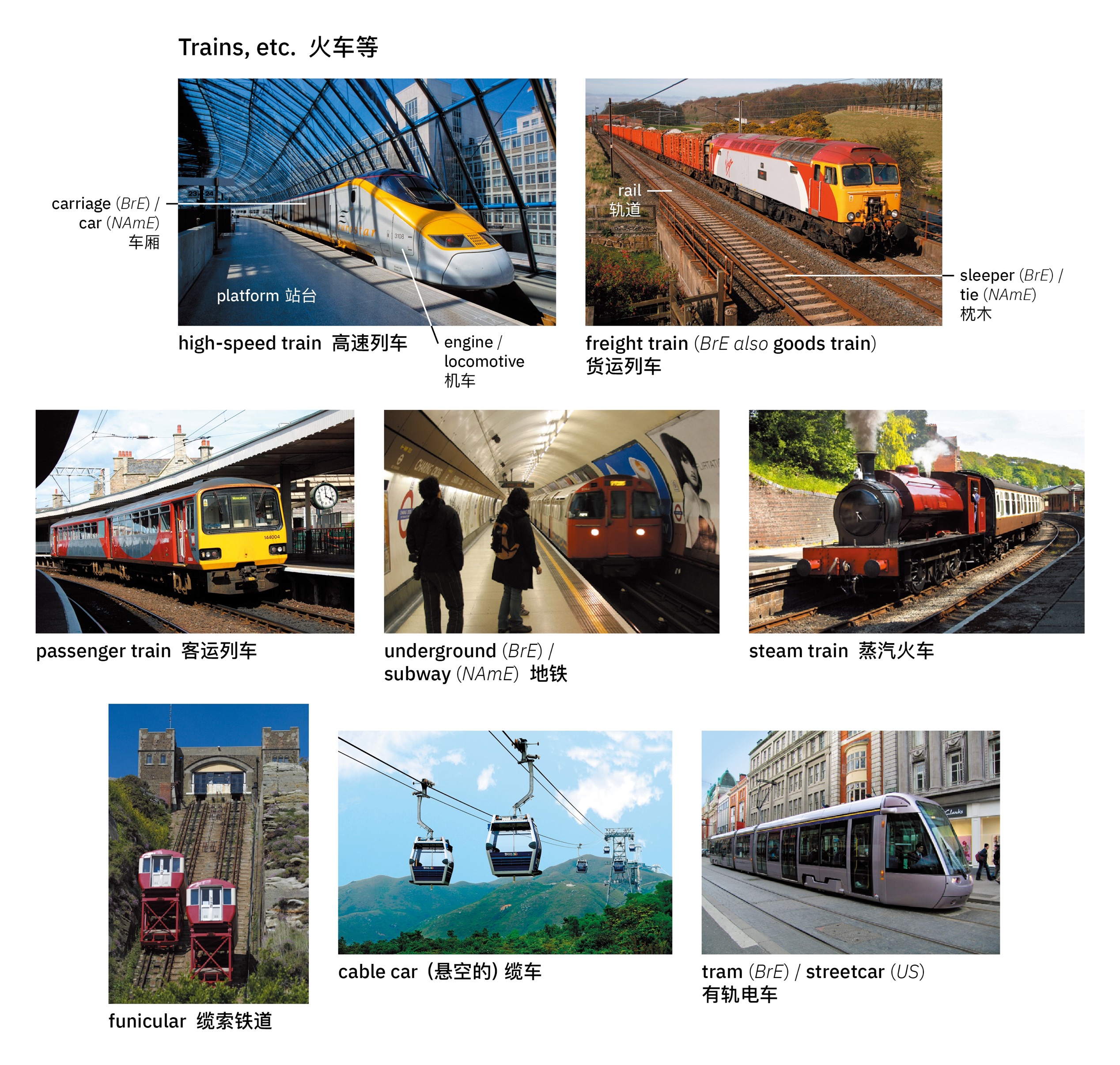
train
Word family
Longman Dictionary of Contemporary English 5++LDOCE 5++train1 /treɪn/ ●●● S1 W2 noun [countable] 1  railway 铁路TTT a set of several carriages that are connected to each other and pulled along a railway line by an engine 火车,列车train to the train to Munich 开往慕尼黑的火车by train We went all the way to Inverness by train. 我们一路坐火车到因弗内斯。 → boat train2 SERIES 系列a train of something SERIESa series of events or actions that are related 一系列,一连串〔相关事件或行动〕 The decision set off a train of events which led to his resignation. 这一决定引发了一连串事件,最终导致了他的辞职。3 train of thought THINK something/HAVE A THOUGHTa related series of thoughts that are developing in your mind 思路 The phone interrupted my train of thought. 电话铃声打断了我的思路。 I’ve lost my train of thought. 我的思路断了。4 bring something in its train formalRESULT if an action or event brings something in its train, that thing happens as a result of it 引发某事 a decision that brought disaster in its train 最后酿成灾难的一项决定5 set something in train British English formalSTART something/MAKE something START to make a process start happening 使某事开始启动 Plans to modernize have been set in train. 现代化计划已经启动。6 people/animals 人/动物LINE a long line of moving people, animals, or vehicles 〔行进中的〕行列,队列 a camel train 一支驼队7 dress 裙子DCC a part of a long dress that spreads out over the ground behind the person wearing it 裙裾,拖裾 a wedding dress with a long train 后摆很长的结婚礼服8. servants 仆从LINE a group of servants or officers following an important person, especially in the past 〔尤指旧时重要人物的〕随行人员,随从n GRAMMAR: Patterns with train• You usually say get on a train: I got on the train at Bristol. • You usually say get off a train: She got off the train in Geneva. • You say that someone is on a train: There were a lot of tourists on the train.• You go somewhere by train: He travels to work by train. ✗Don’t say: go by the train | travel by the train• You often talk about the train: It’s easier if you take the train. COLLOCATIONSverbstake/get a train 乘火车I took the first train home. 我乘坐第一班火车回家。catch a train 赶火车He was in a hurry to catch a train. 他匆匆去赶火车。go by/travel by train 坐火车We decided to go by train. 我们决定坐火车去。get on/board a train 上火车At Stoke, another passenger boarded the train. 在斯托克,又上来一名乘客。get off a train 下火车nHe got off the train at Flushing.wait for a train 等火车nShe sat on the railway platform for half an hour, waiting for a train.miss a train (=be too late to get on a train) 没赶上火车nI just missed the last train.trains run (=take people from one place to another at fixed times) 火车按班次行驶nTrains run from two main London stations, Victoria and Charing Cross, every hour.a train arrives 火车到达nThe train arrived on time.a train leaves/departs 火车出发nTrains depart from Rugby at half-hourly intervals until 4.00 pm.a train pulls into/out of a station 火车进站/出站nThe train pulled into Euston station and I got off.na train derails/is derailed (=comes off the rails)Most of the passengers escaped injury when their train was derailed.ADJECTIVES/NOUN + traina freight/goods train 货运列车a freight train carrying hazardous chemicals 运载着危险化学品的一辆货运列车a passenger train 客运列车a passenger train bound for Geneva 开往日内瓦的一列客车a commuter train (=a train that people going to work use) 通勤列车na crash involving two crowded commuter trainsan express train/a fast train (=one that does not stop at many places) 快车nHe boarded the express train to London.a slow train (also a stopping train British English) (=one that stops at a lot of places) 慢车nWe got on the stopping train by mistake and it took hours to get home.na steam trainRailway enthusiasts have the opportunity to take a nostalgic trip on a steam train.na tube/underground train (=one that runs under London)The condition of many tube trains is a disgrace.train + NOUNna train journey British English, a train trip American EnglishThey were not looking forward to the long train journey. 他们并不想坐长途火车旅行。a train fare 火车票价How much is the train fare to Derby? 到德比的火车票多少钱?a train driver 火车司机nThe train driver apologized for the late departure.a train crash (also a train wreck American English) 火车相撞事故nTen people were killed in the train crash.5COMMON ERRORS 常见错误 ► Don’t say ‘go by the train’ or ‘travel by the train’. Say go by train or travel by train . 不要说 ‘go by the train’ 或 ‘travel by the train’。 而要说 go by train 或 travel by train 。
Examples from the Corpus
train• We parted at Paddington, and assured them that they would have to change trains at Oxford.• Caltrain runs commuter trains to both destinations and to other Silicon Valley cities, culminating in San Francisco.• As the mail train thundered past and disappeared into the distance he heard the familiar sound of footsteps.• But he made it, and got to the station just before the train did.• Comment on the dollar had been sombre for much of the year in the train of developments the previous autumn.• a wagon traintrain to• an overnight train to Viennatrain2 ●●● S1 W2 verb 1 teach SB 训练某人 [intransitive, transitive]SETTEACH to teach someone the skills of a particular job or activity, or to be taught these skills (接受)训练;(被)培训 → trainingtrain somebody in something All staff will be trained in customer service skills. 所有员工都将接受客户服务技能的培训。train to do something She’s training to be a doctor. 她正在接受医生培训。train somebody to do something Employees are trained to deal with emergency situations. 雇员接受过应急情况处理的培训。train as Nadia trained as a singer. 纳迪娅受过歌唱训练。 a highly trained workforce 训练有素的劳动力 Trained staff will be available to deal with your queries. 我们会有受过培训的员工来解答你的问题。► see thesaurus at learn, teach2 teach an animal 训练动物 [transitive]TEACH to teach an animal to do something or to behave correctly 训练 a well-trained puppy 受过很好训练的小狗train something to do something These dogs are trained to detect drugs. 这些狗受过训练,能嗅出毒品。3 prepare for sport 为体育赛事而训练 [intransitive, transitive]DSEXERCISE to prepare for a sports event or tell someone how to prepare for it, especially by exercising 〔为准备体育赛事而〕训练,操练 → training4 aim STH 瞄准某物 [transitive]SHOOT to aim something such as a gun or camera at someone or something 把〔枪、相机等〕瞄准,对准5 develop STH 培养某事物 [transitive] to develop and improve a natural ability or quality 教育,培养〔能力或素质〕6. plant 植物 [transitive]DLG to make a plant grow in a particular direction by bending, cutting, or tying it 使〔植物〕按照特定方向生长→ See Verb tableExamples from the Corpus
train• Hamilton trains and sells horses.• Chris trained at an airbase in Honduras.• I'm not as fit as I should be. I don't train enough.• Melanie trained for a career in music, but switched to photography in her early thirties.• The troops had been training for an important role in the battle.• We want to encourage people who left school early to train for better jobs.• Tyson is training for the big fight next week.• She's been training for the marathon for six months.• These teams will be trained in direction and how to participate in problem solving.• The team is currently training in Hampshire.• In the winter months, she trains in Montana.• If you're really going to run in the marathon, you need to start training now.• We train people in skills such as typing and business administration.• A lot of employers don't train their staff properly.• Julie is training to be a nurse.• Her husband trained to be an auto mechanic, but he can't find a job.• Mr Gorman recently trained to become a chiropractor.• The dog was trained to detect illegal drugs.• All employees will be trained to use the new computer system.• The staff must be trained to use the software correctly.• We train twice a week at the local gym.train somebody in something• The report could only be understood by someone who is trained in chemistry.train something to do something• The dogs have been trained to attack intruders.train for• I started training for this race in September.trained eye• An alert mind and trained eye give astute evaluations.• The badge was coded to reveal to the trained eye just how much clearance the owner had.• His actions were deliberate, his trained eye looking for any bugs that might be hidden in the room.• In fact, tuition and advice are available in a multitude of sports under the trained eye of friendly, experienced coaches.• For only a moment, hardly discernable, except to a trained eye, the old Dimitri Volkov had shown himself.From Longman Business Dictionarytraintrain1 /treɪn/ noun [countable] a number of connected carriages pulled by an engine on a railway line → goods train → see also gravy traintraintrain2 verb [intransitive, transitive] to teach someone or to be taught the skills and knowledge needed for a particular jobBoth my sons want to train as chartered accountants.train somebody in somethingOne of the major costs of implementing the technology was the need to train workers in new skills.train somebody to do somethingHe trains his people to identify customer needs clearly. —trained adjectiveThe recession makes it even more essential to have properlytrained staff.→ See Verb tableOrigin train1 (1400-1500) Old French “something that is pulled along behind”, from trainer; → TRAIN2 train2 (1300-1400) Old French trainer “to pull, drag”, from Vulgar Latin traginare, probably from Latin trahere “to pull”train1 noun →n GRAMMAR1 →COLLOCATIONS1train2 verbLDOCE OnlineChinese
Corpus are set that of Business a carriages several
train
train1 S1 W2 /treɪn/ 
 noun [countable]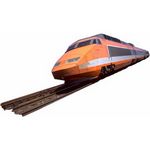
1. RAILWAY a set of several carriages that are connected to each other and pulled along a railway line by an engine
train to

the train to Munich
We went all the way to Inverness by train. ⇨ boat train
2. SERIES a train of something a series of events or actions that are related:
The decision set off a train of events which led to his resignation.
3. train of thought a related series of thoughts that are developing in your mind:
The phone interrupted my train of thought.
I’ve lost my train of thought.
4. bring something in its train formal if an action or event brings something in its train, that thing happens as a result of it:
a decision that brought disaster in its train
5. set something in train British English formal to make a process start happening:
Plans to modernize have been set in train.
6. PEOPLE/ANIMALS a long line of moving people, animals, or vehicles:
a camel train
7. DRESS a part of a long dress that spreads out over the ground behind the person wearing it:
a wedding dress with a long train
8. SERVANTS a group of servants or officers following an important person, especially in the past
■ verbs
▪take/get a train I took the first train home.
▪catch a train He was in a hurry to catch a train.
▪go by/travel by train We decided to go by train.
▪get on/board a train At Stoke, another passenger boarded the train.
▪get off a train He got off the train at Flushing.
▪wait for a train She sat on the railway platform for half an hour, waiting for a train.
▪miss a train (=be too late to get on a train) I just missed the last train.
▪trains run (=take people from one place to another at fixed times) Trains run from two main London stations, Victoria and Charing Cross, every hour.
▪a train arrives The train arrived on time.
▪a train leaves/departs Trains depart from Rugby at half-hourly intervals until 4.00 pm.
▪a train pulls into/out of a station The train pulled into Euston station and I got off.
▪a train derails/is derailed (=comes off the rails) Most of the passengers escaped injury when their train was derailed.
■ adjectives/NOUN + train
▪a freight/goods train a freight train carrying hazardous chemicals
▪a passenger train a passenger train bound for Geneva
▪a commuter train (=a train that people going to work use) a crash involving two crowded commuter trains
▪an express train/a fast train (=one that does not stop at many places) He boarded the express train to London.
▪a slow train (also a stopping train British English) (=one that stops at a lot of places) We got on the stopping train by mistake and it took hours to get home.
▪a steam train Railway enthusiasts have the opportunity to take a nostalgic trip on a steam train.
▪a tube/underground train (=one that runs under London) The condition of many tube trains is a disgrace.
■ train + NOUN
▪a train journey British English, a train trip American English They were not looking forward to the long train journey.
▪a train fare How much is the train fare to Derby?
▪a train driver The train driver apologized for the late departure.
▪a train crash (also a train wreck American English) Ten people were killed in the train crash.
■ COMMON ERRORS
► Do not say 'go by the train' or 'travel by the train'. Say go by train or travel by train.
train2 S1 W2 verb
train somebody in something
All staff will be trained in customer service skills.
train to do something
She’s training to be a doctor.
train somebody to do something
Employees are trained to deal with emergency situations.
train as
Nadia trained as a singer.
a highly trained workforce
Trained staff will be available to deal with your queries.
2. TEACH AN ANIMAL [transitive] to teach an animal to do something or to behave correctly:
a well-trained puppy
train something to do something
These dogs are trained to detect drugs.
3. PREPARE FOR SPORT [intransitive and transitive] to prepare for a sports event or tell someone how to prepare for it, especially by exercising ⇨ training
train for
Brenda spends two hours a day training for the marathon.
4. AIM SOMETHING [transitive] to aim something such as a gun or camera at someone or something
train something on/at somebody/something
She trained her binoculars on the bird.
5. DEVELOP SOMETHING [transitive] to develop and improve a natural ability or quality:
You can train your mind to relax.
To the trained eye the difference between these flowers is obvious (=the difference is clear to someone who has developed skills to notice something).
6. PLANT [transitive] to make a plant grow in a particular direction by bending, cutting, or tying it
| I |
noun [countable] Date: 1400-1500
Language: Old French
Origin: 'something that is pulled along behind', from trainer; ⇨ train2
Language: Old French
Origin: 'something that is pulled along behind', from trainer; ⇨ train2
1. RAILWAY a set of several carriages that are connected to each other and pulled along a railway line by an engine
train to
2. SERIES a train of something a series of events or actions that are related:
3. train of thought a related series of thoughts that are developing in your mind:
4. bring something in its train formal if an action or event brings something in its train, that thing happens as a result of it:
5. set something in train British English formal to make a process start happening:
6. PEOPLE/ANIMALS a long line of moving people, animals, or vehicles:
7. DRESS a part of a long dress that spreads out over the ground behind the person wearing it:
8. SERVANTS a group of servants or officers following an important person, especially in the past
| COLLOCATIONS |
▪
▪
▪
▪
▪
▪
▪
▪
▪
▪
▪
▪
■ adjectives/NOUN + train
▪
▪
▪
▪
▪
▪
▪
■ train + NOUN
▪
▪
▪
▪
■ COMMON ERRORS
► Do not say 'go by the train' or 'travel by the train'. Say go by train or travel by train.
| II |
verb Word Family: noun: trainee, trainer, training, retraining; verb: train, retrain; adjective: trained ≠ untrained
Date: 1300-1400
Language: Old French
Origin: trainer 'to pull, drag', from Vulgar Latin traginare, probably from Latin trahere 'to pull'
1. TEACH SOMEBODY [intransitive and transitive] to teach someone the skills of a particular job or activity, or to be taught these skills ⇨ trainingLanguage: Old French
Origin: trainer 'to pull, drag', from Vulgar Latin traginare, probably from Latin trahere 'to pull'
train somebody in something
train to do something
train somebody to do something
train as
2. TEACH AN ANIMAL [transitive] to teach an animal to do something or to behave correctly:
train something to do something
3. PREPARE FOR SPORT [intransitive and transitive] to prepare for a sports event or tell someone how to prepare for it, especially by exercising ⇨ training
train for
4. AIM SOMETHING [transitive] to aim something such as a gun or camera at someone or something
train something on/at somebody/something
5. DEVELOP SOMETHING [transitive] to develop and improve a natural ability or quality:
6. PLANT [transitive] to make a plant grow in a particular direction by bending, cutting, or tying it