waiter
Longman Dictionary of Contemporary English 5++LDOCE 5++wait·er /ˈweɪtə $ -ər/ ●●● S3 noun [countable]  BODFa man who serves food and drink at the tables in a restaurant 〔餐馆的〕男服务员,男侍者
BODFa man who serves food and drink at the tables in a restaurant 〔餐馆的〕男服务员,男侍者Examples from the Corpus
waiter• He'd been a waiter for twenty years-and this was the day he broke free. ext.• The House bill also excludes tipped workers, such as waiters who currently earn $ 2. 13 an hour.• A GOOD-LOOKING waiter produces a light.• Their black gowns flowed to the floor where they were frequently trampled underfoot by passing waiters.• A woman goes to a curry house and annoys the waiter.• No one said a word until the waiters wheeled in the centrepiece of the main course.• When the waiter had served our entrees, a lull settled in.wait·er nounChineseSyllable
serves in tables and at food drink who Corpus man the a
See ldoce4328jpg for more
waiter
wait‧er /ˈweɪtə $ -ər/
 noun [countable]
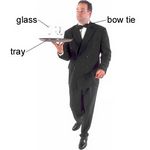
a man who serves food and drink at the tables in a restaurant
wait‧er /ˈweɪtə $ -ər/
noun [countable]a man who serves food and drink at the tables in a restaurant
Ways of talking about men and women 表示男女的说法
When you are writing or speaking English it is important to use language that includes both men and women equally. Some people may be very offended if you do not. 说写英语时,重要的是用词要把男女都包括在内,否则可能会冒犯某些人。
The human race 人类
Man andmankind have traditionally been used to mean 'all men and women'. Many people now prefer to usehumanity ,the human race ,human beings orpeople .* man 和 mankind 传统上用以指所有男性和女性,不过,现在许多人喜欢用 humanity、the human race、human beings 或 people。
Jobs 职业
The suffix -ess in names of occupations such asactress ,hostess andwaitress shows that the person doing the job is a woman. Many people now avoid these. Instead you can useactor orhost (althoughactress andhostess are still very common), or a neutral word, such asserver forwaiter andwaitress .后缀 -ess 在职业的名称如 actress、hostess 和 waitress 中表明从事此职业的是女性。目前,许多人避免用这些词。取而代之的是 actor 或 host(尽管 actress 和 hostess 仍然很常见)或用中性词如 server 取代 waiter 和 waitress。 Neutral words like assistant ,worker ,person orofficer are now often used instead of-man or-woman in the names of jobs. For example, you can usepolice officer instead ofpoliceman orpolicewoman , andspokesperson instead ofspokesman orspokeswoman . Neutral words are very common in newspapers, on television and radio and in official writing, in bothBrE NAmE 现在职业名称常用中性词如 assistant、worker、person 或 officer 取代 -man 或 -woman。例如可用 police officer 代替 policeman 或 policewoman,用 spokesperson 代替 spokesman 或 spokeswoman。在报刊、电视、广播和公文中,英式英语和美式英语都常用中性词。 When talking about jobs that are traditionally done by the other sex, some people say: a male secretary /nurse /model (NOTman ) ora woman /female doctor /barrister /driver . However this is now not usually used unless you need to emphasize which sex the person is, or it is still unusual for the job to be done by a man/woman.谈及传统上由另一性别干的工作时,有人用 male secretary/nurse/model(不用 man)或 woman/female doctor/barrister/driver 表示。不过现在这种用法不常见,除非要强调此人的性别,或由某性别干此工作仍然少见 :◆ My daughter prefers to see a woman doctor. 我的女儿喜欢让女医生看病。 ◆ They have a male nanny for their kids. 他们有个男保姆照料孩子。 ◆ a female racing driver 女赛车手
Pronouns 代词
He used to be considered to cover both men and women.* he 过去被认为既指男性也指女性 :◆ Everyone needs to feel he is loved. 人人都需要有被爱的感觉。 This is not now acceptable. Instead, after everybody ,everyone ,anybody ,anyone ,somebody ,someone , etc. one of the plural pronounsthey ,them , andtheir is often used.现在此用法不获认同。取而代之的是在 everybody、everyone、anybody、anyone、somebody、someone 等之后常用复数代词 they、them 和 their :◆ Does everybody know what they want? 人人都知道自己需要什么吗? ◆ Somebody's left their coat here. 有人把外衣落在这儿了。 ◆ I hope nobody's forgotten to bring their passport with them. 希望没人忘了随身带上护照。 Some people prefer to use he or she ,his or her , orhim or her in speech and writing.有人在口语和书面语中喜欢用 he or she、his or her 或 him or her :◆ Everyone knows what's best for him- or herself. 人人都知道对自己来说什么是最好的。 He/she or(s)he can also be used in writing.* he/she 或 (s)he 亦可用于书面语中 :◆ If in doubt, ask your doctor. He/she can give you more information. 如有疑问请向你的医生咨询,他/她会给你更多的信息。 (You may find that some writers just use 'she'.) 有些人只用 she。 :These uses can seem awkward when they are used a lot. It is better to try to change the sentence, using a plural noun. 这种说法用得太多可能显得别扭。最好尽量改动句子,用复数名词。 :Instead of saying 避免说 :◆ A baby cries when he or she is tired you can say 可以说 :◆ Babies cry when they are tired. 婴儿疲倦时会哭。
Eating out 去餐馆吃饭
eat (lunch/dinner)/dine/meet at/in a restaurant在一家餐馆吃(午/晚)饭/进餐/碰面 go (out)/take sb (out) for lunch/dinner/a meal去/带某人去(外面)吃午饭/吃晚饭/用餐 have a meal with sb与某人一起吃饭 make/have a reservation (in/under the name of Yamada)(以山田的名字)预订座位 reserve/ ( especially
BrE book a table for six预订一张坐六人的桌子 ask for/request a table for two/a table by the window要一张两人桌/靠窗的桌子
In the restaurant 在餐馆
wait to be seated等待就座 show sb to their table把某人引到桌旁 sit in the corner/by the window/at the bar/at the counter坐在角落/窗边/吧台边/柜台边 hand sb/give sb the menu/wine list把菜单/酒水单递给某人 open/read/study/peruse the menu打开/看/仔细看菜单 the restaurant has a three-course set menu/a children's menu/an extensive wine list这餐馆有一个三道菜的套餐/儿童菜单/丰富的酒水单 taste/sample/try the wine品尝葡萄酒 the waiter takes your order服务生帮你点餐 order/choose/have the soup of the day/one of the specials/the house( speciality/BrE ( specialtyespecially
NAmE 点当日例汤/一道特色菜/餐馆特色菜 serve/finish the first course/the starter/the main course/dessert/coffee端上/吃完第一道菜/开胃菜/主菜/甜点;端上/喝完咖啡 complain about the food/the service/your meal抱怨食物/服务/饭菜不好 enjoy your meal享用饭菜
Paying 结账
pay/ask for ( the bill/especially
BrE ( the checkNAmE 付账;要求结账 pay for/treat sb to dinner/lunch/the meal付晚饭/午饭/饭钱;请某人吃晚饭/午饭/饭 service is (not) included 不含服务费 give sb/leave (sb) a tip给某人小费
Eating out 去餐馆吃饭
eat (lunch/dinner)/dine/meet at/in a restaurant在一家餐馆吃(午/晚)饭/进餐/碰面 go (out)/take sb (out) for lunch/dinner/a meal去/带某人去(外面)吃午饭/吃晚饭/用餐 have a meal with sb与某人一起吃饭 make/have a reservation (in/under the name of Yamada)(以山田的名字)预订座位 reserve/ ( especially
BrE book a table for six预订一张坐六人的桌子 ask for/request a table for two/a table by the window要一张两人桌/靠窗的桌子
In the restaurant 在餐馆
wait to be seated等待就座 show sb to their table把某人引到桌旁 sit in the corner/by the window/at the bar/at the counter坐在角落/窗边/吧台边/柜台边 hand sb/give sb the menu/wine list把菜单/酒水单递给某人 open/read/study/peruse the menu打开/看/仔细看菜单 the restaurant has a three-course set menu/a children's menu/an extensive wine list这餐馆有一个三道菜的套餐/儿童菜单/丰富的酒水单 taste/sample/try the wine品尝葡萄酒 the waiter takes your order服务生帮你点餐 order/choose/have the soup of the day/one of the specials/the house( speciality/BrE ( specialtyespecially
NAmE 点当日例汤/一道特色菜/餐馆特色菜 serve/finish the first course/the starter/the main course/dessert/coffee端上/吃完第一道菜/开胃菜/主菜/甜点;端上/喝完咖啡 complain about the food/the service/your meal抱怨食物/服务/饭菜不好 enjoy your meal享用饭菜
Paying 结账
pay/ask for ( the bill/especially
BrE ( the checkNAmE 付账;要求结账 pay for/treat sb to dinner/lunch/the meal付晚饭/午饭/饭钱;请某人吃晚饭/午饭/饭 service is (not) included 不含服务费 give sb/leave (sb) a tip给某人小费